
Reviewed by Dr Emelie Fogelberg, BSc, DVM

Tapeworms are intestinal parasites that can infect dogs at any stage of life. Some tapeworms can cause obvious signs, such as an itchy bottom and the appearance of small, rice-like segments crawling around the dog’s bottom, whereas others can be difficult to detect, with dogs appearing completely healthy.1,2
For Australian dog owners, one tapeworm deserves particular attention: the hydatid tapeworm, Echinococcus granulosus. Unlike the more familiar flea tapeworm, hydatid tapeworm is important not only because it infects dogs, but because infected dogs are the source of transmission of deadly hydatid disease to people.3,4
Because of the potentially severe consequences of hydatid disease in people, experts recommend that dogs at risk receive a tapeworming treatment every month.3,9
What are tapeworms in dogs?
Tapeworms are flat, segmented worms that live in the intestine. Dogs can be infected with several species, and the way infection occurs depends on the parasite.
Flea tapeworm (Dipylidium caninum): Dogs become infected when they swallow an infected flea or chewing louse, usually while grooming. Flea tapeworm infections are common and are usually asymptomatic, or the dog might scoot their bottom along the ground and have visible wriggling tapeworm segments in their faeces or near their bottom.1
Taenia species: Dogs can become infected by eating infected animals, raw untreated meat or offal. These tapeworms are particularly relevant to dogs that hunt or scavenge. 2
Hydatid tapeworm (Echinococcus granulosus): Dogs become infected when they eat infected tissues or offal from an intermediate host. In Australia, this can involve livestock, wallabies, kangaroos or feral pigs. Dogs carrying hydatid tapeworm are unlikely to show any clinical signs or symptoms.3,4
What are the signs of tapeworms in dogs?
Tapeworm infections can be easy to miss and are difficult to diagnose by faecal tests.
When signs are present, they can include scooting or irritation around the anus, visible tapeworm segments in faeces or around the dog’s bottom, digestive upset and, in heavier infections, weight loss or abdominal discomfort. Flea tapeworm segments may look like grains of rice.1,2
Dogs infected with dangerous hydatid tapeworm are unlikely to show clinical signs, so the absence of symptoms does not rule out infection.4
How do dogs get tapeworms?
The route of infection depends on the type of tapeworm. Understanding the lifecycle helps explain why different prevention measures are needed.
Fleas: A flea can act as the intermediate host for Dipylidium caninum. When a dog swallows an infected flea during grooming, the tapeworm can mature in the intestine.1
Prey and scavenging: Dogs that hunt or scavenge may ingest tapeworm cysts in infected intermediate hosts or carcass material.2,5
Raw offal: Eating infected offal is an important route of hydatid infection. Independent experts recommend limiting dogs’ access to offal from domestic or wild intermediate hosts.4
Travel and outdoor exposure: A dog does not need to live rurally to encounter different parasite risks. Travel to rural or regional areas, bushwalking, off-lead exploration and contact with wildlife can change the environments and animals a dog encounters. Studies have shown high prevalence of hydatid tapeworm in wallabies, kangaroos and wild dogs throughout Australia9-13 and the Victorian Department of Health specifically identifies urban dogs travelling to rural areas as a potential part of the hydatid transmission cycle.3
Hydatid Tapeworm Infection in Dogs: An Important Australian Concern
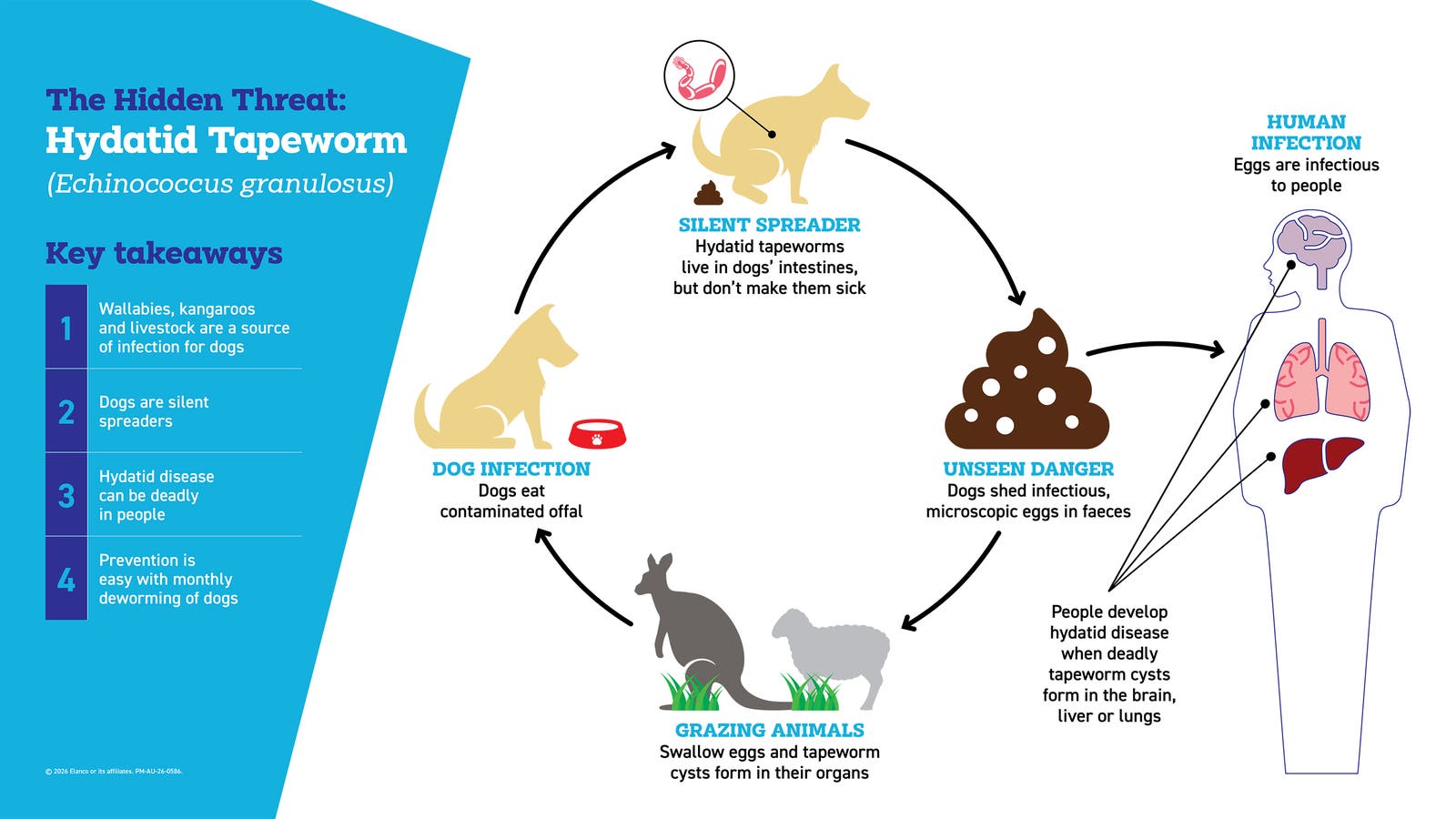
Hydatid tapeworm infection in dogs is linked to the hydatid tapeworm, Echinococcus granulosus. For Australian dog owners, it is worth understanding both sides of the problem: the dog can carry adult hydatid tapeworms without obvious illness, while people can develop hydatid disease after accidentally ingesting microscopic and long-lasting tapeworm eggs shed in the poo of an infected dog.3,4
Hydatid disease, also called cystic echinococcosis, is caused by the larval stage of Echinococcus granulosus. Dogs and other canids are definitive hosts: which means that the adult tapeworms live in their intestines, releasing eggs that pass into the environment in faeces.3,4
Sheep are an important intermediate host in the traditional dog–sheep cycle, but the parasite can also involve wildlife. The Victorian Department of Health notes that hydatid infection has been associated with rural areas and identifies kangaroos and other wildlife within the Australian transmission context.3
Australian veterinary labelling guidance also reflects the importance of hydatid control: the APVMA states that a generic tapeworm-control claim for dogs is only permitted where a product has demonstrated greater than 99% removal of hydatid tapeworm, and it provides specific guidance for treatment in hydatid areas.7
People can become accidental intermediate hosts by ingesting Echinococcus granulosus eggs. Larvae hatch from their eggs, then travel through our body, before developing into large fluid-filled hydatid cysts within our organs - typically liver or lungs. Hydatid disease can have a long incubation period of months to years and may become life threatening when cysts grow, leak or rupture.3,4
Does my dog need to live on a farm to be at risk?
No. Where a dog lives is only part of the picture. Exposure is more useful to consider in terms of lifestyle, travel and what the dog can access.
- being off lead in bushland or areas where wildlife is present;
- scavenging or eating carcasses or animal remains;
- travelling with the family to rural or regional areas, including camping or holidays;
- visiting properties where livestock or wildlife are present; and
- being fed raw untreated offal or organs from livestock or wildlife.3-5
This does not mean that every dog has the same level of hydatid risk, nor that a regional shelter, boarding facility or travel destination is itself a source of infection. The relevant issue is whether the dog has opportunities to encounter infected animals, or contaminated environments.
Can humans get tapeworms from dogs?
Some canine tapeworms are zoonotic, meaning they can infect people. The route of infection varies by parasite. People can acquire flea tapeworm if they accidentally swallow an infected flea, while hydatid disease occurs when people ingest Echinococcus granulosus eggs from an infected dog or contaminated environment.1,4
Because hydatid tapeworm does not make dogs sick, but poses a deadly risk to human health, it is a family health and public health concern. The Victorian Department of Health highlights the importance of prevention and hygiene, particularly because young children may have closer contact with dogs and may be less consistent with hygiene practices, for example, washing their hands after cuddling with the dog or after playing outside where the dog has defaecated.3
The concern is accidental ingestion of infectious eggs. Good hand hygiene, prompt removal of dog faeces, preventing scavenging and appropriate parasite control all form part of reducing zoonotic risk.3,5
Concerned about your exposure to tapeworms? Take our quiz to see if you or your family is at risk here.
How can I prevent tapeworms in my dog?
Good parasite prevention combines appropriate treatment with sensible management of exposure.
Control fleas: Keeping dogs free of fleas helps prevent flea tapeworm infection because infected fleas are the intermediate host for Dipylidium caninum.1
Prevent scavenging: Do not allow dogs to eat carcasses, wildlife remains or potentially infected animal material. 2,5
Avoid raw offal: Do not feed dogs raw offal or meat from livestock or wildlife. This is particularly important where hydatid or Taenia exposure is a concern.4,5
Think about lifestyle: Discuss parasite protection with your veterinarian if your dog hunts, scavenges, explores off-leash in parks close to bush (where there are wallabies, kangaroos or feral pigs) or on farms (where there could be sheep and other livestock).3,5
Practice good hygiene: Remove dog faeces promptly and wash hands after handling dogs, dog faeces, soil or potentially contaminated environments (e.g. gardening or playing in the backyard), particularly before eating.3,5
How are tapeworms treated in dogs?
Praziquantel is the established treatment for canine tapeworms.1,4
Independent experts now recommend that dogs at risk of tapeworm should be treated with praziquantel monthly. This is to prevent dogs from shedding infectious hydatid eggs into the environment, to protect public health.6,9
Choosing parasite protection for your dog
All-in-one products do not necessarily provide identical protection against every parasite. When comparing products, it is worth checking whether it contains praziquantel and can kill tapeworms, or if it only prevents flea tapeworm through flea control.
Every all-in-one product prevents flea tapeworm infestation through their effective flea control. This is an important part of breaking the flea tapeworm lifecycle, but it is not the same as a direct claim to treat or kill tapeworms. This means that if a dog is already infected with a flea tapeworm, you need a product that kills the worms in the dog, not just controlling the flea population on the dog.
Advocate Ultra Chew protects dogs against the broadest range of parasites*, including tapeworms, in an easy to give monthly chew that's safe for dogs from 8 weeks of age.
That gives dog owners an all-in-one option with direct tapeworm treatment and control, rather than relying on flea control alone to help prevent flea tapeworm infection only. The product’s broadest-spectrum claim is based on the number of parasite species controlled among canine all-in-one products that protect against fleas, ticks, heartworm and intestinal worms.
Your veterinarian can help you choose the most appropriate parasite protection based on your dog’s age, lifestyle, travel, diet and exposure to wildlife or other potential sources of infection.
FAQs
PRODUCTS
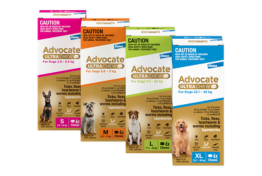
Advocate™ Ultra Chew for dogs
Advocate Ultra Chew offers the broadest spectrum parasite protection*^ against ticks, fleas, demodex mites, heartworm disease and intestinal worms including tapeworms.




References
9. Harriott, L. et al. Wildlife Research, 2019, 46, 212–221.
10. Jenkins, D. J., & Morris, B. Aust Vet J. 2003. 81(1-2), 81–85.
11. Grainger, H. J., & Jenkins, D. J. Int J for Parasitol, 1996. 26(11), 1263–1270.
12. Reichel, M. P., Lyford, R. A., & Gasser, R. B. (1994). Medical Journal of Australia, 160(8), 499–501.
13. Thompson, R. C., et al. (1988). Aust Vet J, 65(6), 188–190.
*Of all canine endectocides, based on the number of parasite species controlled.
Read the product leaflet for full instructions. Advocate, Elanco and the diagonal bar logo are trade marks of Elanco or its affiliates. © 2026 Elanco or its affiliates. For further information contact Elanco Australasia Pty Ltd (ABN 64 076 745 198): productsupportau@elancoah.com.
